


In the swampy, mosquito-choked permafrost of the Uyuk Valley in southern Siberia—a desolate landscape known to archaeologists as the “Siberian Valley of the Kings”—researchers have achieved what sounds like a technical impossibility: they successfully administered a forensic drug test to a human being who died around the dawn of the eighth century BCE[1][2][3].
The subject came back positive[1].
The monumental royal burial mound known as Tunnug 1 has yielded over 1,400 ancient cannabis seeds and remarkably preserved braids of human hair[1][4][5]. Analyzed via high-resolution mass spectrometry by an international consortium led by Dr. Gino Caspari (University of Bern and the Max Planck Institute of Geoanthropology), the hair revealed distinct molecular traces of cannabinol (CBN)—the stable oxidation product of delta-9-tetrahydrocannabinol (THC)—alongside trace signatures of THC itself[6][7][8].
The discovery pushes the confirmed timeline for human psychoactive cannabis use back by at least 300 years[2][6], predating both the wooden braziers of the Pamir Mountains and the famous accounts of the Greek historian Herodotus[2][9].
Yet behind the triumph of molecular archaeology lies an enigmatic, violent ritual landscape. The tomb did not merely cradle narcotics; it was an epicenter of mass slaughter, filled with dozens of sacrificed warhorses and mutilated human remains[8][9]. The discovery leaves us suspended between empirical biochemical fact, provocative anthropological speculation, and the enduring shadows of forensic doubt.

1. The Forensic Breakthrough: Botany Meets Mass Spectrometry
For decades, the archaeology of prehistoric intoxicants has been plagued by circumstantial evidence. Hemp fiber and seeds appear across Neolithic Eurasia, but discovering seeds in a grave does not prove the dead were intoxicating themselves; cannabis was cultivated extensively for cordage, textile fiber, and nutrient-dense, non-psychoactive food oil[6][10].
At Tunnug 1, the evidence transitioned from botanical association to direct bodily incorporation[10]:

The recovery of 1,481 whole and fragmented cannabis seeds from burial layers dated to ~2,800 BP established the deliberate inclusion of the plant[5][7]. But it was the hair that crossed the threshold into human pharmacology[10]. As human hair grows, cannabinoids circulating in the bloodstream through the capillary bed of the dermal papilla become embedded within the keratinized matrix of the hair shaft.
Using high-resolution mass spectrometry, Caspari’s team detected cannabinol at an average concentration of 560 parts per billion (0.56 micrograms per gram)[5]. Because CBN is the primary thermal- and oxidative degradation metabolite of THC[8][9], its chemical presence inside three-millennia-old human keratin provides the earliest direct biomolecular proof that early steppe nomads were absorbing psychoactive cannabinoids[6][7].

2. Chronological Shockwaves: Pre-Dating Herodotus
The discovery fundamentally recalibrates our understanding of nomadic pastoralist pharmacology.
| Site / Text | Region | Date | Nature of Evidence |
| Tunnug 1 (Caspari et al.)[2][6] | Uyuk Valley, Tuva, Siberia | c. 800–790 BCE | Direct bio-marker (THC/CBN in human hair; seeds)[1][6][11] |
| Jirzankal Cemetery | Pamir Mountains, China | c. 500 BCE | Indirect chemical residue (Cannabinol on heated brazier stones) |
| Herodotus, The Histories[9] | Pontic-Caspian Steppe | c. 440 BCE | Textual narrative (Accounts of Scythian tent vapor baths)[2][9] |
| Pazyryk Kurgans | Altai Mountains | c. 400–300 BCE | Artifactual (Copper censers, charcoal, seeds in permafrost) |
For nearly two and a half millennia, modern historians treated Herodotus’s description of Scythians in The Histories (Book IV, 73–75) with measured skepticism[9]. Herodotus wrote that Scythians erected felt tents, placed red-hot stones inside saucers, and cast hemp seeds upon them:
“The Scythians take the seed of this hemp and, creeping under the mats, throw it upon red-hot stones; it smoulders and sends forth such fumes that no Greek vapour-bath could surpass it. The Scythians howl in joy for the vapour-bath.”[9]
Tunnug 1 proves that this ritual was not a late, Hellenistic-era development witnessed on the fringes of the Black Sea. Instead, it was an ancient, deeply entrenched cultural fixture born hundreds of miles to the northeast in the inner Eurasian steppes, four centuries before Herodotus put stylus to papyrus[9].
3. The Speculative Frontier: Ecstatic Shamanism or Brutal Sedation?
The most intellectually arresting—and morally chilling—aspect of the Tunnug 1 discovery is not that people consumed cannabis, but why they were given it in this specific context[11].
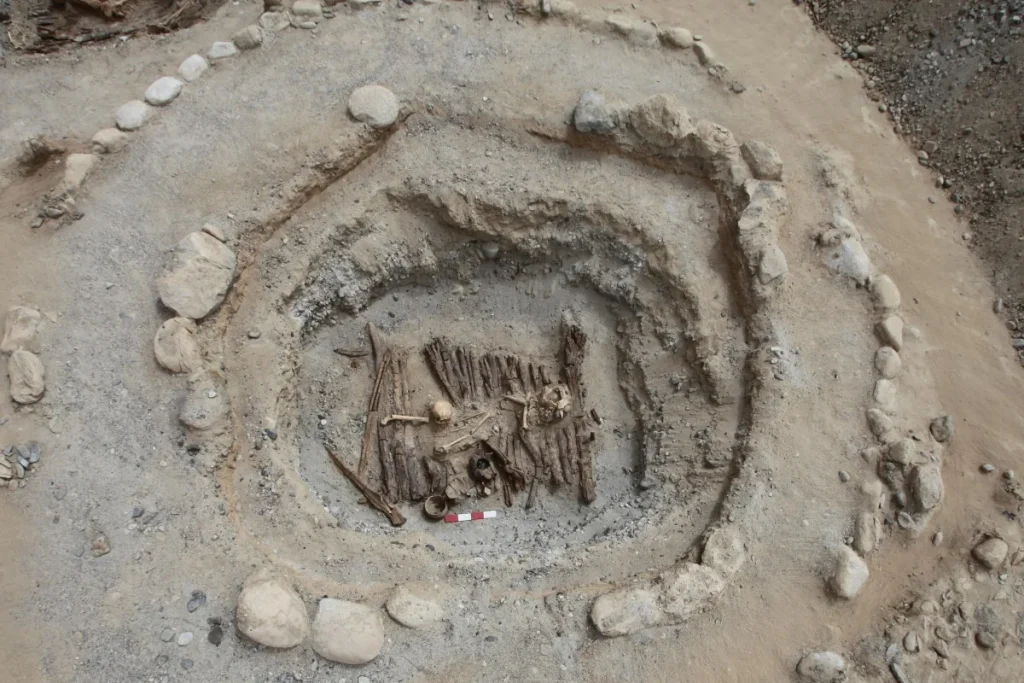
The Archeology of Slaughter
Tunnug 1 is not a peaceful family cemetery; it is an early Scythian kurgan measuring 140 meters in diameter, built above a subterranean wooden palace designed to usher an elite chieftain into the afterlife[7][11]. Surrounding the central burial chamber, excavators uncovered the shattered remains of at least 18 sacrificed horses, elaborate weaponry, and fragmented skeletons indicating ritual human sacrifice[2][9].
Nomadic elite burials were theatrical displays of catastrophic expenditure: when the ruler fell, his mounts, his attendants, and his consorts often fell with him[1][9].
The Darker Hypothesis
Dr. Gino Caspari raised a speculative, deeply haunting possibility: cannabis may have been administered as a pre-execution sedative to calm human sacrificial victims before they were killed.[8][9]
Ritual strangulation, bludgeoning, and disarticulation are physically chaotic affairs. A thrashing, terrified human victim spoils the sacred dignity of an imperial funeral. Did the priests and shamans of the Uyuk Valley deploy potent infusions or enclosed fumigation tents to induce a state of tranquilized compliance in those chosen to follow their lord into the earth?
Caspari is rigorously clear: this hypothesis cannot be scientifically proven. We have the chemistry and we have the corpses; the narrative bridging them is an informed act of archaeological deduction[9].
Alternatively, the consumption may have been the prerogative of the elite: either the deceased leader using cannabis for chronic pain relief during life, or the surviving mourners engaging in ecstatic, communal grief to establish contact with ancestral spirits.
4. The Shadow of a Doubt: Methodological Caveats
While the presence of cannabinoids is indisputable, a rigorous analysis demands that we preserve a critical “shadow of a doubt” regarding what these chemical traces actually mean.
1. Ingestion vs. Inhalation vs. External Contamination
A mass spectrometer measures molecular mass; it does not come with an eye-witness testimony[8].
- The Route of Administration: Did this individual ingest cannabis orally (as an infusion, seed cake, or resin paste), or did they inhale it through the lungs[2][8]? Modern forensic toxicology struggles to differentiate oral ingestion from heavy inhalation based solely on hair concentrations[12][13].
- Passive Smoke Deposition: If a person sits inside a small, airtight felt yurt while cannabis flowers are thrown onto burning stones, their hair will be coated in airborne smoke particulates[8][11]. While laboratories wash hair vigorously to remove surface contamination before dissolving the keratin matrix, microscopic cannabinoids can penetrate the hair cuticle from dense environmental smoke without the individual ever actively smoking or even necessarily experiencing a deep systemic high.
2. Taphonomic Transformation Over 2,800 Years
The hair lay for nearly three millennia in an unstable environment subject to freezing, thawing, microbial action, and waterlogged sediment[2].
- CBN is an oxidation byproduct of THC[6][8]. Did the individual absorb THC that naturally degraded in the body, or did a massive dose of external smoke degrade into CBN across thousands of years of exposure to subterranean moisture and oxygen[1][8]?
3. Identity and Provenance
Whose hair was tested? In the structural collapse of ancient kurgans—often looted in antiquity or shifted by permafrost movements—human remains can become commingled. Was the tested hair that of the high-status lord, an attendant, a mourner who cut their locks in grief, or one of the sacrificed victims[1][8]? Without secure, uncompromised skeletal association for every hair strand, attributing the state of intoxication to a specific actor in the burial drama remains an open question.
Conclusion: The Steppe’s Ghostly Vapor
The discoveries at Tunnug 1 strip away the modern, sterilized perception of cannabis as a product of counter-culture revolutions or contemporary dispensaries. They anchor the plant firmly where it truly belongs: in the raw, primal, and often terrifying foundational rituals of human civilization.
Twenty-eight hundred years ago, in the shadow of the Sayan Mountains, human beings gathered around fire and timber[1][11]. They understood that this wild plant held the power to dissolve consciousness, bridge the realm of the living and the dead, and perhaps ease the journey of those about to die[6][9]. Science has finally caught up with the chemistry of their smoke—even if the full truth of their intentions remains forever locked behind the frozen turf of the Siberian plain.
Sources


Imagining the very first steppe riders or shamans sitting around a glowing bronze cauldron in the freezing Siberian permafrost, their internal monologue probably went something like this:
“Wait… is that horse looking at me like it knows I’m eating its grass?”
“Why is this hot rock making me care so much about the architectural design of this tent?”
“Did someone just say ‘mammoth,’ or did my ears get heavy?”
“We have been staring at this fire for four winters. Or four minutes. Time is a flat steppe.”
“I bet if we wrap these fibers around a stick, it’s just a really long thought.”
“It’s minus twenty degrees outside, yet my shoulder feels like a warm potato.”
“Should we tell the tribe, or do we keep the magic warm rocks a secret forever?”