

The Legend of Hitler in Patagonia: The Inalco Mansion and German U-Boats
After WWII, an estimated 9,000 Nazi war criminals fled Europe for South America. Discover how government ratlines, false passports, and local networks shielded them from justice.

The theory that Adolf Hitler survived the fall of Berlin in 1945 and escaped to Argentina is one of the most enduring alternative historical narratives of the modern era. While mainstream historians and forensic scientists maintain that Hitler died by suicide in his Berlin bunker on April 30, 1945, the escape narrative persists in popular culture, literature, and documentaries.
To examine this topic objectively, it is necessary to analyze the origin of the escape theories, the historical context of post-war Argentina that made the narrative plausible, the specific claims put forward by proponents, and the scientific evidence that refutes them.
1. The Origins of the Escape Narrative
The belief that Hitler escaped did not originate solely in post-war tabloid culture; its initial seeds were sown by geopolitics and early Cold War disinformation.
- Soviet Disinformation: Immediately after the capture of Berlin, Soviet authorities under Joseph Stalin deliberately fostered confusion regarding Hitler’s fate. At the Potsdam Conference in July 1945, Stalin told U.S. President Harry Truman and British Prime Minister Winston Churchill that he believed Hitler had escaped, suggesting he was hiding in Spain or South America. This was part of a geopolitical strategy to sow distrust among the Western Allies and keep the Soviet population vigilant against a perceived fascist threat.
- The Secrecy of the Bunker Remains: Because the Soviets recovered Hitler’s partially charred remains, kept them in secret archives, and did not share their physical evidence with Western intelligence for decades, rumors flourished. The lack of public, verifiable photographic or physical evidence in 1945 allowed speculative theories to fill the vacuum.
2. Why Argentina? The Reality of the “Ratlines”
The theory of Hitler’s escape to Argentina gained widespread plausibility because the country did, in fact, become a safe haven for thousands of high-ranking Nazi officials after the war.
- The Perón Government’s Policy: Under President Juan Perón, Argentina actively facilitated the escape of European fascists and Nazis through organized networks known as “ratlines.” Perón viewed the Nuremberg Trials as a victor’s justice and sought to recruit European scientists, technicians, and military officers to bolster Argentina’s industrial and military capabilities.
- Confirmed Fugitives: Notorious war criminals successfully fled to Argentina, including:
- Adolf Eichmann: The architect of the “Final Solution,” who lived under an alias in Buenos Aires until he was captured by Israel’s Mossad in 1960.
- Dr. Josef Mengele: The Auschwitz physician who lived in Buenos Aires and Bariloche before moving to Paraguay and Brazil.
- Erich Priebke: An SS commander responsible for the Ardeatine massacre in Italy, who lived openly in the Patagonian resort town of San Carlos de Bariloche for decades.
- Established German Communities: Regions like Patagonia, particularly Bariloche, already had established, secluded German-immigrant communities before World War II. The existence of these remote, culturally familiar enclaves provided a realistic backdrop for theories of Hitler living in isolation.
3. Key Claims of the Escape Theory
Proponents of the escape theory, such as the authors of the book Grey Wolf: The Escape of Adolf Hitler, base their arguments on several key pieces of circumstantial evidence and declassified documents:

- The Arrival of U-Boats: In July and August 1945, two German submarines—the U-530 and U-977—surrendered to the Argentine Navy in Mar del Plata. Theorists argue these submarines, or others like them, were part of a secret convoy that transported Hitler, Eva Braun, and Nazi gold to the remote shores of Patagonia before surrendering.
- The Inalco Mansion: Theorists frequently point to the Inalco Estate, a remote, Bavarian-style mansion built in 1943 near Villa La Angostura in Patagonia. Accessible primarily by water or difficult mountain paths, the estate was rumored to have been constructed specifically to house Hitler in exile.
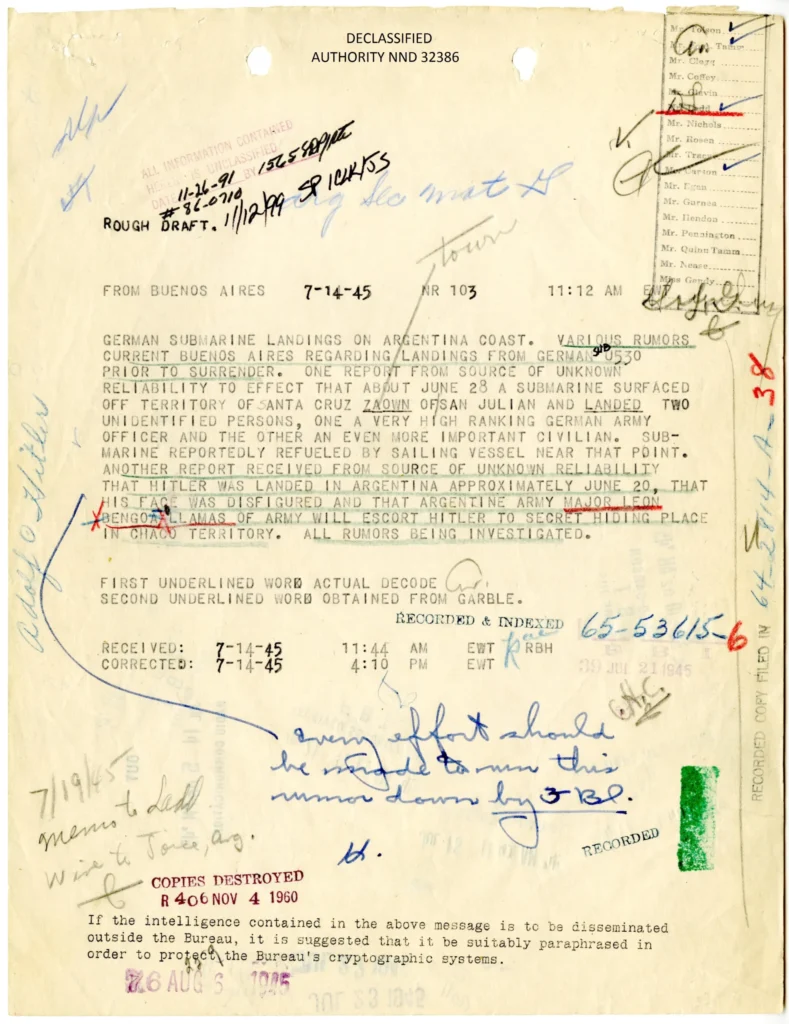
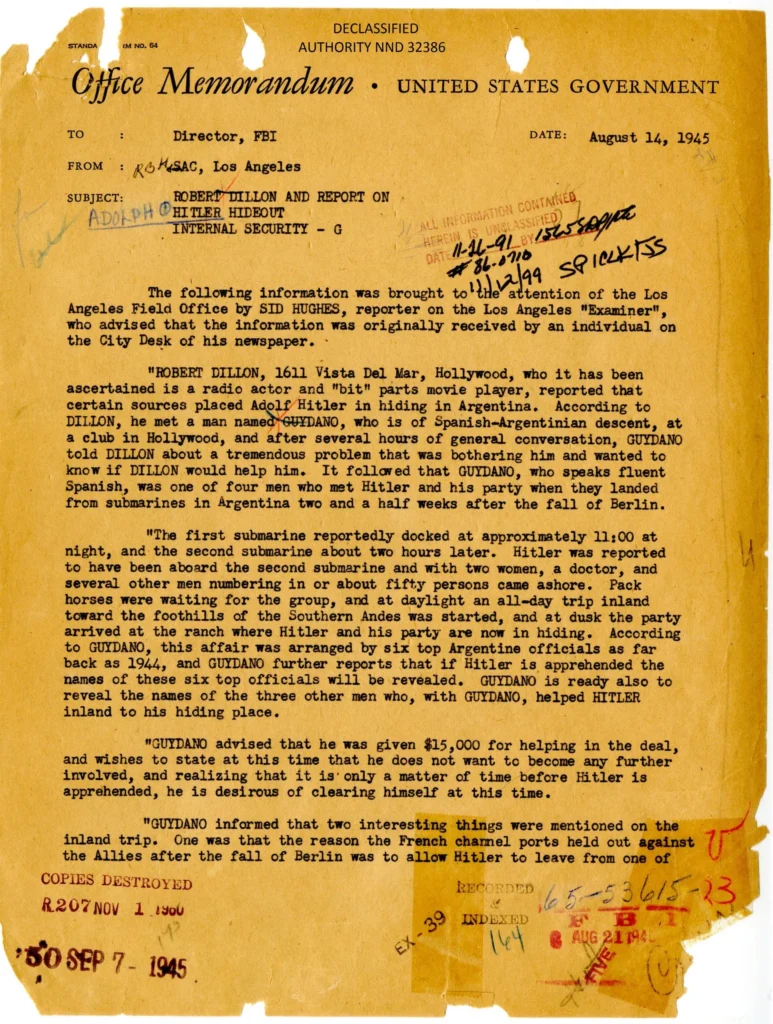
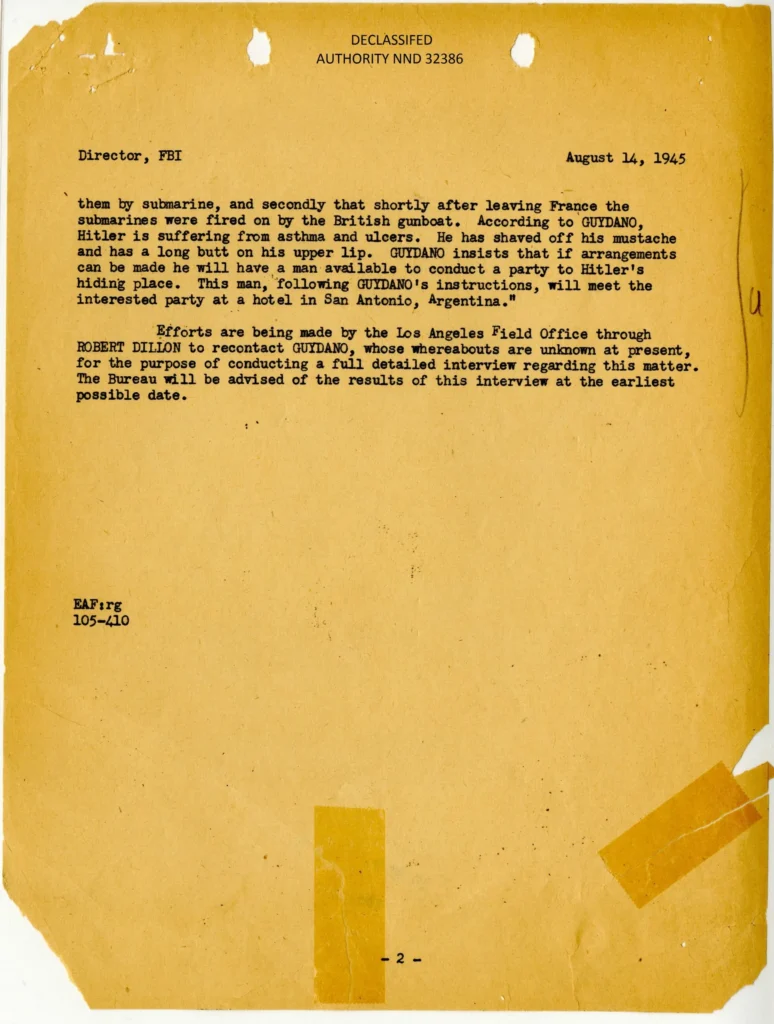
- Declassified FBI and CIA Files: Following the Freedom of Information Act (FOIA) releases, thousands of pages of FBI and CIA documents from the 1940s and 1950s became public. These files contain numerous reports of sightings of Hitler in South America. Theorists cite these documents as proof that U.S. intelligence believed he was alive. However, historians note that intelligence agencies are required to document and investigate all tips—including highly unreliable ones—and the files show that none of these leads were ever substantiated.
4. The Historical and Scientific Refutation
The overwhelming consensus of historians, forensic pathologists, and intelligence agencies is that Hitler died in Berlin. This conclusion is supported by multiple layers of empirical evidence:
- Eyewitness Testimony: Numerous individuals who were present in the Führerbunker during Hitler’s final days—including his press secretary, personal valet (Heinz Linge), military adjutants (Otto Günsche), and secretaries (such as Traudl Junge)—consistently testified under rigorous, independent interrogations by both Soviet and Western authorities. They confirmed the suicide of Hitler and Eva Braun, the subsequent carrying of the bodies to the Reich Chancellery garden, and their cremation.
- The 2017/2018 Forensic Study: In 2017, the Russian government permitted a team of French forensic scientists, led by pathologist Philippe Charlier, to examine the jawbone and skull fragments kept in the state archives in Moscow. The study, published in the European Journal of Internal Medicine in 2018, concluded:
- The dental remains matched Hitler’s official dental records from 1945, which included unique bridgework and dental crowns.
- The teeth showed heavy tartar deposits and no traces of meat fibers, consistent with Hitler’s well-documented vegetarianism.
- There was no evidence of gunpowder or bullet impact on the jawbone, but blue deposits on the dentures suggested a chemical reaction consistent with cyanide ingestion.
- The lead researcher, Charlier, stated unequivocally that the teeth are authentic and prove “without any possible doubt” that Hitler died in Berlin on April 30, 1945.

Nazi Havens in South America: How War Criminals Escaped Post-WWII Justice
While the historic Nuremberg trials prosecuted senior Nazi leaders after World War II, the vast majority of war criminals evaded justice. Historical records and German prosecutors estimate that up to 9,000 Nazi war criminals escaped Europe, with many finding refuge in South America.
According to prosecutorial estimates, the primary destinations included:
- Argentina: Welcomed up to 5,000 Nazis.
- Brazil: Accepted between 1,500 and 2,000 Nazis.
- Chile: Took in between 500 and 1,000 Nazis.
- Paraguay and Bolivia: Absorbed hundreds more.
These fugitives were aided by pre-existing ethnic German communities, sympathetic local governments, and clandestine escape networks.
The Role of Juan Perón and Argentina’s “Ratlines”
Argentina was the primary hub for escaping Nazis, largely due to the policies of President Juan Perón. An admirer of European fascists, Perón actively established secret escape routes—dubbed “ratlines”—to ferry fugitives out of European ports.
Historian Uki Goñi documented that Perón set up a secret office in Bern, Switzerland, to handle the paperwork for escaping Nazi officials. This network relied on key intermediaries, including Argentinian Cardinal Antonio Caggiano, who helped coordinate the pipeline with sympathetic church officials in Europe.
False Passports: The Vatican and the Red Cross
Many escaping Nazis relied on false travel documents provided by highly placed European officials.
Bishop Alois Hudal
Austrian-born Bishop Alois Hudal, working in Rome, was one of the most prominent facilitators. He provided false Vatican-issued identity papers to war criminals. These papers allowed fugitives—including Holocaust architect Adolf Eichmann—to obtain International Red Cross passports and safely sail to South America.
The Red Cross Involvement
Under the post-war presidency of Carl Jacob Burckhardt, the International Red Cross issued thousands of identity documents to German refugees. Because vetting was minimal, hundreds of SS members, including Sobibor and Treblinka commander Franz Stangl, successfully used these Red Cross passports to flee to Brazil and Argentina.
Financial Motives and Money Laundering
The influx of Nazis into South America was not purely ideological; it also involved vast financial networks.
In Argentina, President Perón utilized state machinery to launder over $1 billion belonging to Nazi-owned companies to shield their assets from Allied seizure. Major industrial operations, such as a Mercedes-Benz plant near Buenos Aires where Adolf Eichmann worked, served as hubs for financing the relocation and integration of fugitive Nazis.
Additionally, figures like SS commando Otto Skorzeny and Perón’s wife, Eva “Evita” Perón, were allegedly linked to the management and laundering of hidden Nazi assets.
Notorious Nazi Fugitives Who Found Refuge in South America
Several of the third Reich’s most brutal figures successfully eluded justice for decades:
- Adolf Eichmann: Captured by Israel’s Mossad in Buenos Aires in 1960 and executed in 1962.
- Josef Mengele: The “Angel of Death” of Auschwitz. He fled to Argentina, Paraguay, and finally Brazil, where he drowned in 1979 without ever facing trial.
- Franz Stangl: Commandant of Treblinka and Sobibor. He fled to Brazil but was eventually extradited to Germany in the 1960s, where he died in prison.
- Walter Rauff: Creator of the mobile gas chamber. He lived openly and died in Chile in 1984.
- Klaus Barbie: The “Butcher of Lyon.” He hid in Bolivia, assisting local anti-communist efforts, before being extradited back to France in 1983.
- Eduard Roschmann: The “Butcher of Riga.” He died in Paraguay in 1977.
Uncovering the Truth
The biblical command “Justice, justice shall you pursue” continues to drive historians delving into recently declassified archives. While most of these war criminals have passed away, uncovering the networks that shielded them remains a vital step in documenting the full history of the Holocaust and its aftermath.
Conclusion
The narrative of Adolf Hitler escaping to Argentina is a historical phenomenon built on a mixture of genuine post-war history and speculative lore. The very real existence of the Argentine “ratlines” and the successful flight of high-ranking Nazis like Adolf Eichmann and Josef Mengele created a plausible environment for the rumor to grow. However, when subjected to forensic science, eyewitness cross-examination, and archival research, the claim that Hitler survived lacks empirical support. Historically, the theory is understood as a cultural myth rather than a documented reality.