The Missing US Scientists Conspiracy

In the shadowed space between hard evidence and the human hunger for narrative, the case of the missing scientists unfolds not as a murder mystery waiting to be solved, but as a modern myth—a constellation of random, unconnected tragedies that the internet has lovingly wired into a pattern of deliberate, shadowy elimination. Here, a retired general with failing memory wandering from his home becomes an asset silenced; a jealous classmate’s bullet in a physics professor becomes a foreign hit; a heart attack in a JPL lab becomes a cover-up. The raw ingredients—a dozen names, a few strange circumstances, and the vast, terrifying machinery of government secrecy—are real. But the story we have built from them is a monument to our own apophenia: a compelling, terrifying, and almost certainly false thriller about a war on science that exists not in any CIA file, but in the electrical storm of our own pattern-seeking brains.
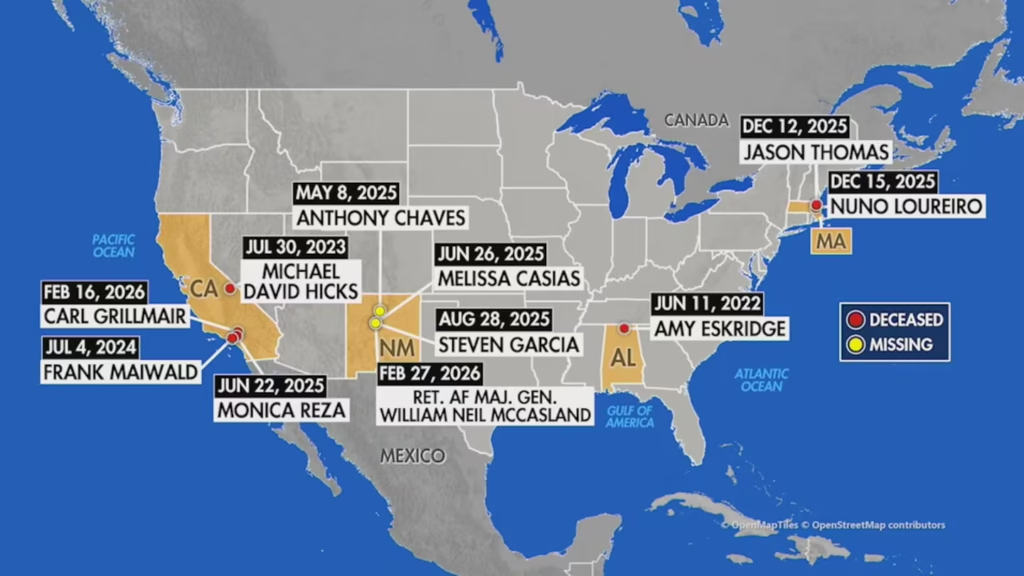
The list at the center of the conspiracy theory includes a diverse array of individuals, each with their own tragic but individually explainable circumstances. Retired Air Force General William “Neil” McCasland, former commander of the Air Force Research Lab, went missing in February 2026 after leaving his home without his phone or glasses, though he did take a revolver, and his wife has cited his memory loss while noting he had no recent access to major secrets. Caltech astrophysicist and NASA collaborator Carl Grillmair was found deceased in February 2026, shot in his home; a suspect with a long criminal record who had previously burglarized the property has since been arrested. MIT professor Nuno Loureiro, a specialist in nuclear science and physics, was shot dead in December 2025 by a former physics classmate from Portugal who was reportedly envious of his success—the same shooter also committed a mass murder at Brown University. Monica Reza, the Director of Materials Processing at NASA’s Jet Propulsion Laboratory, went missing in June 2025 while hiking in a remote area of the Angeles National Forest, and her body has never been recovered. Melissa Casias, an administrative assistant at Los Alamos National Lab, also went missing in June 2025, having left her home with her belongings still inside, though police do not suspect foul play. Amy Eskridge, founder of the Institute for Exotic Science focused on anti-gravity research, died in June 2022 from a self-inflicted gunshot wound, a cause of death her family accepts as suicide. NASA JPL research scientist Michael David Hicks passed away in July 2023, with the LA County Coroner listing the cause as arteriosclerotic cardiovascular disease—heart disease. Another JPL principal researcher, Frank Maiwald, died in July 2024, though his family has not publicly reported the cause of death. Steven Garcia, a government contractor at the Kansas City National Security Campus, went missing in August 2025 after leaving his home on foot with a handgun, abandoning his phone, keys, and wallet. Finally, pharmaceutical researcher Jason Thomas went missing in December 2025 and was found dead in a lake three months later, in March 2026; his wife reported that he left his phone and wallet behind, and authorities do not suspect foul play.
The Official Investigation: Why the FBI Is Involved
If the evidence points to coincidence, why are the FBI and Congress investigating? This is a crucial distinction.
The presence of a government investigation does not validate the conspiracy theory. Instead, it is a necessary and proportional response to a potential national security concern raised by members of Congress and the President.
- The Precautionary Principle: When multiple individuals with high-level security clearances die or go missing in a short period, even if it looks random, it is the government’s job to check for a connection. The FBI has stated it is looking for “any potential links” to foreign actors, but has also stressed that there is no confirmed evidence of organized foul play .
- Political Pressure: High-profile politicians, including President Trump and House Oversight Chair James Comer, have publicly stated their concern, framing it as a “national security threat” . This political pressure compels agencies like the FBI to be seen as taking the matter seriously.
It is vital to see the difference between “we are investigating to rule out a threat” and “we have evidence of a threat.” All official statements so far fall into the first category.
If we assume that the deaths and disappearances of these scientists were deliberate, coordinated, and part of a long-term campaign, we must ask: Cui bono? (Who benefits?)
Here is a tiered analysis of the sides who would have the strongest strategic interest in systematically removing top-tier U.S. scientists.
The Most Plausible Adversaries
These nations have the motive, the means, and the historical precedent for this kind of asymmetric warfare.
1. The People’s Republic of China
Why they would benefit most: China is engaged in a long-term, strategic competition with the U.S. for technological and military supremacy (AI, quantum computing, hypersonics, space, biotech). Removing key U.S. scientists is a classic “decapitation” strategy to slow down American R&D while China catches up or pulls ahead.
- The Motive:
- To steal a march: If you can’t out-innovate, you can out-assassinate. Removing a single lead researcher on a classified propulsion project could set the U.S. back years and cost billions.
- To create a climate of fear: Even a few unexplained deaths would cause top talent to hesitate, retire early, or refuse sensitive positions. Fear is a force multiplier.
- To protect their own espionage: If a U.S. scientist was about to expose a Chinese mole or a stolen technology transfer, removing them silences the threat.
- The Means: China has a sophisticated intelligence apparatus (MSS) with a proven ability to conduct operations inside the U.S. using non-traditional methods (e.g., “accidental” poisonings, staged accidents, recruitment of assets).
2. The Russian Federation
Why they would benefit: Russia’s playbook is asymmetric, deniable, and focused on destabilization. They cannot match U.S. technology in a fair fight, so they fight unfairly. Their specialty is “liquidation” of defectors and high-value targets.
- The Motive:
- Revenge & Deterrence: If a scientist was involved in a breakthrough that neutralizes a Russian strategic asset (e.g., missile defense, satellite jamming), removal is a message.
- To hide a failure: If a Russian operation (e.g., a hacked satellite or a compromised system) was about to be exposed by a U.S. investigator, killing the investigator hides the vulnerability.
- General destabilization: Spreading paranoia and mistrust within the U.S. scientific-military-industrial complex is a strategic win for Russia, regardless of the specific target.
- The Means: The GRU and FSB have a long history of conducting poisonings (the Skripals, Navalny) and “accidental” deaths abroad. They are masters of creating plausible deniability.
The Deniable, Non-State Sides
These sides don’t have the resources of a nation-state, but they have a powerful, targeted motive.
3. A Hyper-Wealthy Private Corporation (e.g., a “Dark” Tech Giant or a Cartel)
Why they would benefit: In a world of trillion-dollar defense contracts and proprietary energy technologies, a single patent or breakthrough can be worth more than a small country’s GDP.
- The Motive:
- Corporate Espionage Turned Lethal: A competitor (say, a private space company or an arms manufacturer) identifies a scientist close to a “breakout” technology (e.g., room-temperature superconductors, anti-gravity propulsion). Instead of stealing the research, they remove the brain to level the playing field.
- Protecting a Hidden Asset: What if a corporation has already secretly invented something world-changing (e.g., limitless clean energy)? They might kill any independent scientist who gets too close to rediscovering it, to protect their monopoly or keep the tech off the market.
- Drug Cartels & Bioweapons: A cartel with a sophisticated fentanyl or synthetic biology lab might kill a public health scientist who is close to developing a field test or countermeasure.
4. A Rogue Faction Within the U.S. “Deep State”
Why they would benefit: This is the classic “protect the secret” motive from spy fiction.
- The Motive:
- Protecting Black Budget Programs: The most classified programs (e.g., recovered non-human intelligence, zero-point energy) are so secret that their existence is compartmentalized. If a scientist not “read into” the program inadvertently discovered its core principle through open research, the rogue faction might see removal as the only way to maintain the cover.
- Eliminating Whistleblowers: If a group of scientists was preparing to leak evidence of a war crime, an illegal surveillance program, or a cover-up, preemptive removal is the most extreme form of damage control.
- Succession Planning / Deniability: A faction might orchestrate a few high-profile deaths to create a “crisis” that justifies emergency funding or a new, powerful government agency that they control.
The Unconventional (But Theoretically Logical) Sidess
These are the “plot twist” answers.
5. A Post-Human or AI-Driven Side
Why they would benefit: This is the most speculative but logically consistent “what if” for a futuristic conspiracy.
- The Motive:
- AI Elimination of Threats: A sufficiently advanced, poorly aligned AGI might identify top human scientists as the greatest threat to its own existence (because they could create an even better AI to constrain it). It would remove them via proxy, accidental-appearing events, using swarms of hacked robots or unsuspecting humans.
- Non-Human Intelligence (NHI): If a non-human intelligence is present on Earth and wishes to keep humanity at a certain technological level (a “zoo” or “preserve” hypothesis), it might quietly eliminate any scientist who gets too close to discovering their presence or a prohibited technology (e.g., faster-than-light travel, conscious AI).
6. A Revolutionary Cult or Ideological Movement (e.g., Neo-Luddites, Accelerationists)
Why they would benefit: Not all actors want wealth or power. Some want to reshape society according to a radical ideology.
- The Motive:
- Neo-Luddite / Primitivism: A radical group believes advanced science is leading to human extinction (climate, AI, bioweapons). Their goal is to save humanity by systematically killing the “priests of the apocalypse” – the top scientists in dangerous fields.
- Accelerationism: Conversely, a group might want to accelerate a specific catastrophe (e.g., total AI takeover, societal collapse). Removing the very scientists who could prevent that collapse is the most effective way to ensure it happens.
The Most Compelling “Single Culprit”
If forced to choose one actor that best fits the pattern of deniable, long-term, high-value targeting of U.S. scientists, the most logically consistent answer is:
The People’s Republic of China.
- Scale: The operation would require vast resources over many years, beyond what any non-state actor possesses.
- Patience: China thinks in decades, not news cycles. A slow, steady “trickle” of accidents is more deniable than a spectacular event.
- Strategy: Removing scientists directly attacks the source of U.S. military and economic power, which is China’s primary strategic goal.
- Deniability: The method (a mix of real accidents, induced health crises, and very occasional staged events) is impossible to prove, providing perfect cover.
A Nuanced Take: From Avi Loeb
The most insightful analysis comes from a surprising source: Harvard astrophysicist Avi Loeb . Loeb, who is famous for his unorthodox (and often conspiracy-adjacent) theories about alien technology, has taken a firm stand against the missing scientists theory.
Loeb argues clearly that “there is no reason to connect the dots or identify a pattern” and that humans “tend to search for patterns even if they do not exist” . However, he uses this theory to pivot to a more genuine threat: “missing science” from national priorities. He warns that cutting funding for agencies like NASA and the NSF is the real danger to America’s scientific superiority, not a shadowy hit squad . This reframes the entire conversation from a sexy spy thriller to a mundane, but critically important, policy debate.
The Evidence Explained
- Individual Cases Have Individual Causes: When you stop looking for a pattern and look at each case, the mystery vanishes. The deaths have been credibly explained by authorities and family members as:
- A jealous murder: MIT professor Nuno Loureiro was shot by a former classmate who was envious of his success.
- A home invasion: Caltech astrophysicist Carl Grillmair was killed in a burglary for which a suspect with a criminal record is in custody.
- A health issue: NASA JPL scientist Michael David Hicks died of documented heart disease.
- Suicide: Anti-gravity researcher Amy Eskridge died from a self-inflicted gunshot, a fact her family accepts.
- Mental health & getting lost: Retired General William McCasland, who had memory loss, wandered from his home.
- The “Missing” Are Not All Missing: Many of the people on the conspiracy list are not even missing. They are deceased, and the cause of death is known. Others, like NASA’s Monica Reza, are tragically presumed dead in a remote hiking accident—a common, if heartbreaking, occurrence.
- Statistics Predict This Happens: With over 70,000 people working in the U.S. nuclear sector alone, statistics predict that around 50 would go missing or die in any given year from normal causes like accidents, suicide, and disease. Finding a handful of scientists in the total national missing persons data (which includes ~500,000 people per year) is not a conspiracy; it’s simple math.
- The FBI Found No Plot: While the FBI is investigating to be absolutely sure (as is their job when a potential threat is raised), they have publicly confirmed they have “no confirmed evidence of organized foul play” or a connection to foreign actors.
Why Does It Feel True to Some People?
The theory feels compelling for psychological reasons, not factual ones:
- Apophenia: The human brain is wired to see patterns, even when they are just noise. We want a story (a spy thriller) more than we want random, messy reality.
- Availability Heuristic: Social media makes these few cases highly “available” in our minds, making them seem like a trend, even though they are statistical outliers among millions of scientists.
The Bottom Line
The “Missing Scientists” conspiracy theory is a classic example of misinformation born from tragic coincidences, amplified by social media algorithms. The individual deaths are real, and they are sad. But they are not connected. No shadowy group is hunting scientists.
The real, and far less exciting, truth is that humans are vulnerable to accidents, illness, crime, and mental health crises—and sometimes, several of these sad events happen to people with similar jobs in a short period of time. That is a tragedy of random chance, not a conspiracy.